Driving test revision • Halifax
DVSA Show Me, Tell Me Questions
A straightforward guide to the vehicle-safety questions you may be asked during your practical car driving test.
Learn what each check means, then practise it in the car. Controls and bonnet layouts vary between vehicles.
What happens on test
Two questions, at different times
The examiner asks the “tell me” question before you start driving. You explain how you would carry out the check.
The “show me” question comes while you are driving. Wait until it is safe, then operate the requested control.
Answering either or both incorrectly normally results in one driving fault. Dangerous or potentially dangerous driving while answering the “show me” question can result in failing the test.
Before you drive
Tell me questions
Tap a question to reveal the key points the examiner is looking for.
1 How would you check the brakes before a journey?
The pedal should not feel spongy or slack. Test the brakes as you move off and check that the vehicle does not pull to one side.
2 Where do you find the recommended tyre pressures, and how do you check them?
Use the manufacturer’s information and a reliable pressure gauge. Check and adjust cold tyres, include the spare if fitted, and refit the valve caps.
3 How do you adjust the head restraint correctly?
The rigid part should be at least level with your eyes or the top of your ears and as close to the back of your head as is comfortable. Some restraints are not adjustable.
4 How would you check tyre tread and general condition?
Look for cuts or bulges. The tread must be at least 1.6 mm across the central three-quarters of the tyre’s width and around its full circumference.
5 How would you check the headlights and tail lights?
Switch them on, using the ignition if needed, then walk around the vehicle to check them. You only need to explain this during the test.
6 How would you know the anti-lock braking system had a fault?
The ABS warning light would stay illuminated or come on to indicate a fault.
7 How would you check the direction indicators?
Operate the indicators or hazard-warning lights, using the ignition if needed, then walk around the vehicle to check them. You only need to explain the check.
8 How would you check the brake lights?
Press the brake pedal and use reflections in windows or doors, or ask someone to stand behind the vehicle and help.
9 How would you check the power-assisted steering?
Keep gentle pressure on the steering wheel as the engine starts; a small movement shows the assistance beginning. Alternatively, the steering should feel assisted just after moving off. Unusually heavy steering may indicate a fault.
10 How do you switch on the rear fog light, and when should it be used?
Turn on the dipped headlights and ignition if needed, operate the rear-fog-light control and check its warning light. Use rear fog lights only when visibility is seriously reduced, generally when you cannot see for more than 100 metres.
11 How do you change from dipped to main-beam headlights?
Use the main-beam control with the ignition or engine on if necessary. The blue main-beam warning light confirms it is on.
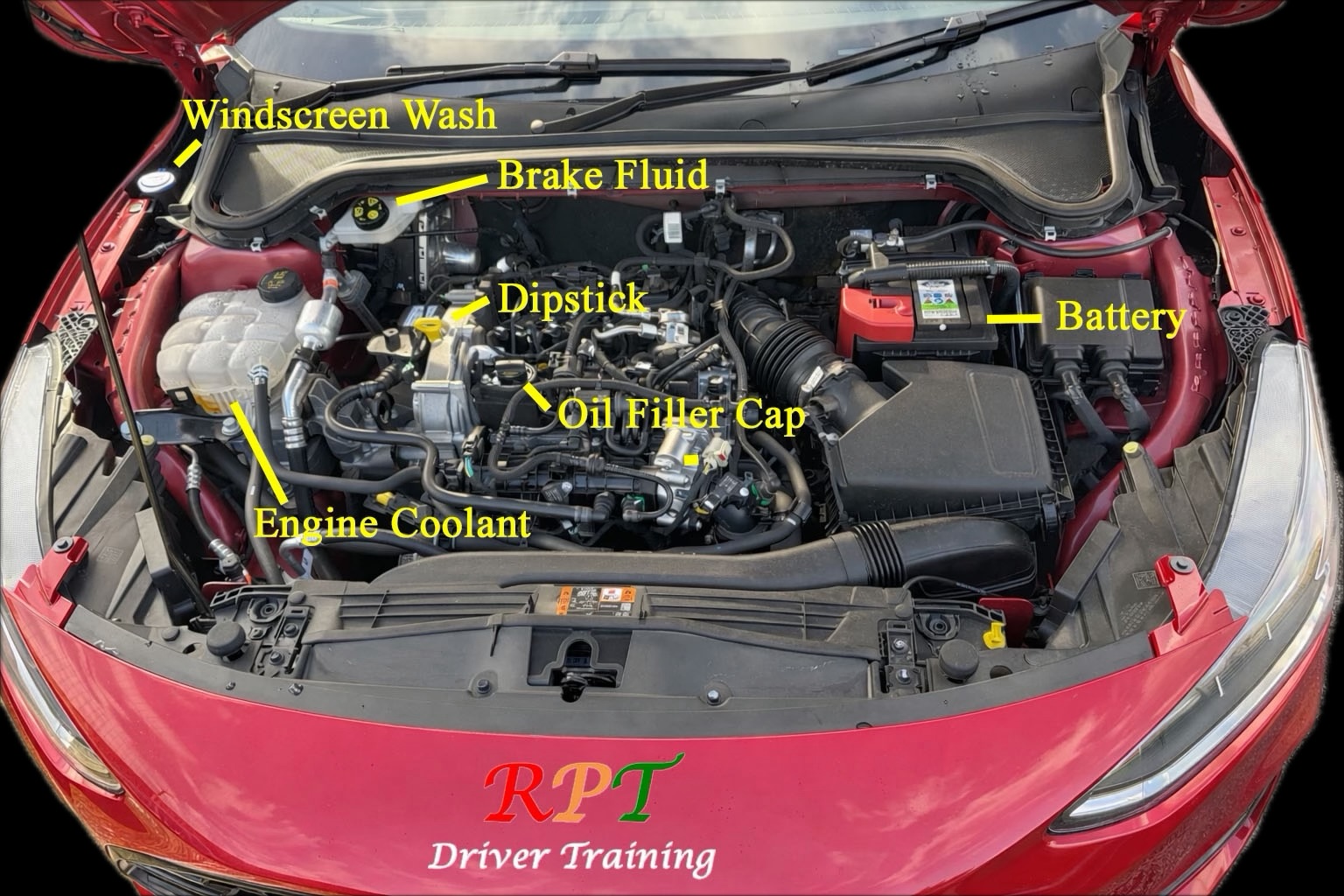
12 Open the bonnet: how would you check the engine-oil level?
Identify the dipstick or electronic oil-level indicator and check that the level is between the minimum and maximum marks. Follow the manufacturer’s method.
13 Open the bonnet: how would you check the engine-coolant level?
Identify the coolant reservoir and check the level against its minimum and maximum markings. Explain how you would top it up to the correct level when the engine is cold.
14 Open the bonnet: how would you check the brake-fluid level?
Identify the brake-fluid reservoir and check that the fluid sits between its minimum and maximum markings.
While you drive
Show me questions
The examiner will begin with “When it’s safe to do so…”. Keep control of the car and only demonstrate the control when it is safe.
- 1Wash and clean the rear windscreen
Operate the rear wash-and-wipe control.
- 2Wash and clean the front windscreen
Operate the front wash-and-wipe control.
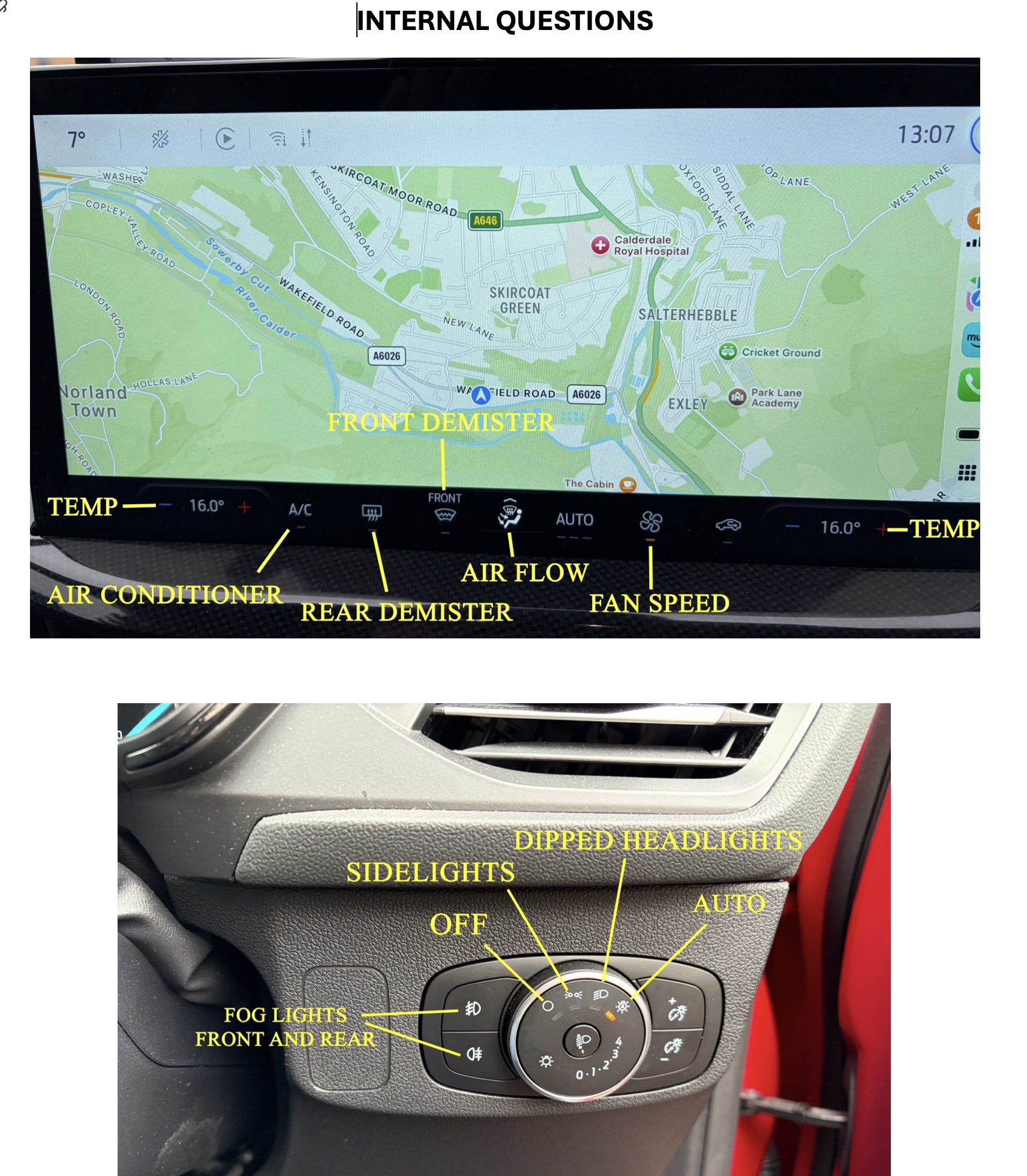
- 3Switch on the dipped headlights
Use the lighting control shown in the photograph.
- 4Set the rear demister
Press the rear heated-window control shown in the photograph.
- 5Operate the horn
Press the horn control when it is safe and legal to do so.
- 6Demist the front windscreen
Set the airflow to the windscreen and adjust the fan and temperature as needed.
- 7Open and close the side window
Use the driver’s electric-window switch.